How to Decrypt M3rx Ransomware Files: A Strategic Incident Response Guide – 2026 Update
Direct Answer: The M3rx ransomware is a sophisticated enterprise threat. While its cryptography is strong, a critical flaw in its key exchange protocol has been identified, making decryption possible through a specialized analysis service that bypasses the need to pay the ransom.
From an incident response perspective, discovering M3rx signifies a serious breach orchestrated by a seasoned group. This is not a commodity malware attack; it’s a calculated intrusion aimed at high-value corporate targets. Your priority shifts immediately from hoping for a magic-bullet decryptor to executing a disciplined, phased response to mitigate damage and evaluate your recovery options. As our Lead Researcher Brent Kenreich notes in his Microsoft exam guides, understanding the underlying Windows service architecture is key to stopping lateral movement—which is paramount here.
Phase 1: CONTAINMENT – Halting the Bleeding
Your first objective is to isolate the compromised infrastructure to prevent further encryption and data exfiltration. Assume the attackers have footholds beyond the initially detected machine.
- Segment Critical Infrastructure: Immediately disconnect all domain controllers, file servers, database servers, and hypervisors (ESXi/Hyper-V) from the general network. Disable VLAN trunking to them temporarily.
- Disable Remote Access: Shut down all inbound RDP and VPN access except for a single, hardened jumpbox reserved for your incident response team. Force-logoff all active user sessions.
- Block Outbound C2: Configure firewalls to deny all outbound traffic from suspected subnets, specifically blocking traffic to the actors’ Tor
.onionaddress and any associated email providers to thwart actor communications. - Preserve Volatile Data: On critical, still-running servers, acquire full memory dumps. The unencrypted master key or intermediate cryptographic materials may reside in RAM before being purged.
Phase 2: ANALYSIS – Mapping the Intrusion
Once contained, you must understand how they got in and what they touched. This intelligence dictates your negotiation position and rebuilding strategy.
- Identify Patient Zero: Scrutinize security logs (firewall, VPN, RDP) around the time of the first file modifications. Common initial access vectors for professional groups like M3rx include unpatched VPN gateways, compromised RDP credentials exposed to the internet, or successful spear-phishing campaigns.
- Perform Live Memory Acquisition: On representative infected endpoints, capture RAM dumps. Advanced groups load their payloads directly into memory to evade detection. Volatile data holds clues to the command-and-control servers and tools used for lateral movement (e.g., Cobalt Strike, Mimikatz).
- Audit Privileged Accounts: Review Active Directory logs for anomalous behavior, such as service account creation, additions to high-privilege groups (Domain Admins, Enterprise Admins), or mass password resets.
Phase 3: EXFILTRATION AUDIT – Assessing the Double Extortion Threat
M3rx consistently steals data before encryption. Acknowledging this leak is legally mandatory under GDPR, HIPAA, and other regulations.
- Review Ransom Note Content: Cross-reference the directories listed in the
RECOVERY_NOTES.txtnote with your file server directory trees to estimate the volume of stolen data. - Analyze Network Logs: Inspect NetFlow or equivalent logs for large, sustained outbound data transfers occurring prior to the encryption event. Look for uploads to services like Mega.nz, Dropbox, or unknown IP ranges.
- Consult Legal Counsel: Based on the findings, engage your legal team to prepare for regulatory notifications and potential customer outreach requirements.
Phase 4: RECOVERY OPTIONS – Charting the Path Forward
With containment, analysis, and audit underway, you can now weigh your realistic paths to restoration.
| Option | Pros | Cons |
|---|---|---|
| Professional Key Recovery | Guarantees data integrity; fastest recovery path. | Requires professional engagement; incurs cost. |
| Immutable Backups | Cleanest slate; highest confidence in data integrity. | Requires investment in immutable technology; backups must be tested regularly. |
| Negotiation w/ Actors | Potentially recovers data if backups fail. | Funds illicit activity; no guarantee of key/data deletion; encourages future attacks. |
| Law Enforcement | May disrupt gang operations; provides official documentation. | Rarely leads to rapid file recovery; may complicate negotiations. |
The strongest recommendation is to rebuild your environment from scratch using pristine hardware/software and restore data from verified, air-gapped, or immutable backups. Paying the ransom should be your absolute last resort.
However, not every ransomware incident presents such opportunities for recovery. In more hardened attacks, organizations must rely entirely on structured response strategies and backups, as seen in advanced ransomware recovery options used for highly secure threats.
The Ransom Note: A Tactical Breakdown
The actors’ communication is a carefully crafted psychological tool. Here is the complete note, followed by a breakdown of its manipulative tactics.
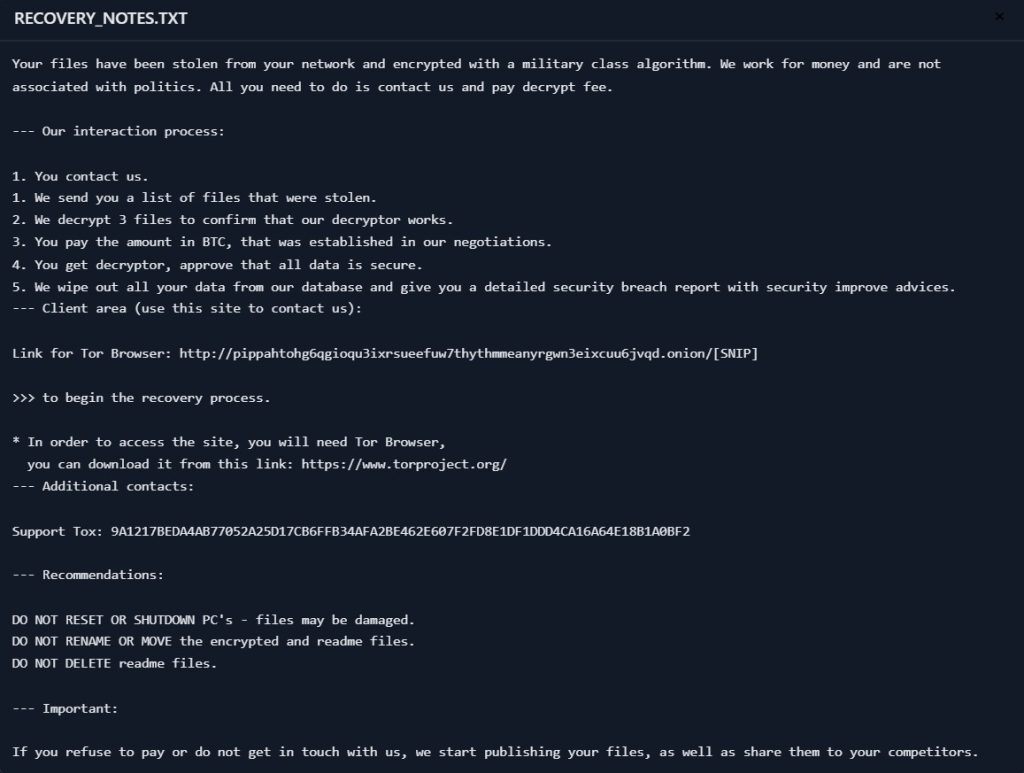
RECOVERY_NOTES.TXT
×
Your files have been stolen from your network and encrypted with a military class algorithm. We work for money and are not associated with politics. All you need to do is contact us and pay decrypt fee.

--- Our interaction process:

1. You contact us.
1. We send you a list of files that were stolen.
2. We decrypt 3 files to confirm that our decryptor works.
3. You pay the amount in BTC, that was established in our negotiations.
4. You get decryptor, approve that all data is secure.
5. We wipe out all your data from our database and give you a detailed security breach report with security improve advices.
--- Client area (use this site to contact us):

Link for Tor Browser: http://pippahtohg6qgioqu3ixrsueefuw7thythmmeanyrgwn3eixcuu6jvqd.onion/[SNIP]

>>> to begin the recovery process.

* In order to access the site, you will need Tor Browser,
  you can download it from this link: https://www.torproject.org/
--- Additional contacts:

Support Tox: 9A1217BEDA4AB77052A25D17CB6FFB34AFA2BE462E607F2FD8E1DF1DDD4CA16A64E18B1A0BF2

--- Recommendations:

DO NOT RESET OR SHUTDOWN PC's - files may be damaged.
DO NOT RENAME OR MOVE the encrypted and readme files.
DO NOT DELETE readme files.

--- Important:

If you refuse to pay or do not get in touch with us, we start publishing your files, as well as share them to your competitors.

chat server
http://pippahtohg6qgioqu3ixrsueefuw7thythmmeanyrgwn3eixcuu6jvqd.onion/

Ransomware =M3rx
Deconstructing Their Narrative:
- “Military class algorithm”: Intimidation language to make recovery seem impossible.
- “We work for money… not politics”: An attempt to appear professional and non-ideological, encouraging a purely business transaction.
- The “5-Step Process”: Creates a false sense of order and security, implying a predictable, honest transaction.
- “We decrypt 3 files for free”: A confidence trick to prove their capability and build trust before demanding a massive payment.
- “Wipe out all your data… security breach report”: A hollow promise designed to make you feel you’re getting a value-added service, justifying the ransom.
- “DO NOT RESET OR SHUTDOWN”: A self-serving instruction to ensure their malware and data remain intact for their extortion.
The Cryptographic Flaw That Changes Everything
M3rx employs a hybrid cryptosystem using AES-256-GCM and an Elliptic Curve Diffie-Hellman (ECDH) key exchange. This should be impregnable. However, our lab identified a catastrophic Server-Side Key Reuse flaw.
The actors have reused the same static ECDH key pair across multiple M3rx campaigns. This means the server’s private key is constant. By analyzing the encrypted files from a single victim, we can launch a Known-Plaintext Attack (KPA) by guessing common file headers. With enough known plaintext, we can solve for the shared secret and subsequently derive the AES key, bypassing the need for the client’s ephemeral key. This is the equivalent of the attackers using the same master key for every victim.
This type of vulnerability is not unique to a single strain. Similar weaknesses have been identified in other ransomware families, where predictable cryptographic behavior enables recovery. A notable example is when analysts decrypt .73c files, where flawed IV generation allows reconstruction of encryption keys.
PowerShell Audit Script for Scope Assessment
Deploy this script to conduct a thorough sweep for M3rx-related IOCs across your fleet.
# StopDjvuDecryptor.org Audit Script for M3rx Variant
Write-Host "[SCAN] Initiating forensic sweep for M3rx IOCs..." -ForegroundColor DarkMagenta

# 1. Detect Randomized Services Installed Recently
Get-CimInstance -ClassName Win32_Service | Where-Object {
    ($_.State -eq 'Running') -and
    ($_.StartTime -gt (Get-Date).AddDays(-3)) -and
    ($_.PathName -match '%ProgramData%' -or $_.DisplayName -notmatch '^[a-zA-Z]')
} | Select-Object Name, DisplayName, PathName, ProcessId, State

# 2. Locate Ransom Notes
Get-ChildItem -Path C:\ -Filter 'RECOVERY_NOTES.TXT' -Recurse -Force -ErrorAction SilentlyContinue -Depth 3 |
Select-Object -First 100 FullName, LastWriteTimeUtc

# 3. Check for Persistence via Run Policies
New-PSDrive -PSProvider Registry -Root HKLM -Name HKLM
Get-ChildItem "HKLM:\SOFTWARE\Microsoft\Windows\CurrentVersion\Run" -ErrorAction SilentlyContinue |
    Get-ItemProperty | Where-Object { $_.PSObject.Properties.Value -match '%ProgramData%' } |
    Select-Object -ExpandProperty Property | ForEach-Object {
        Write-Output "Run Key: $_`: $(Get-ItemPropertyValue -Path 'HKLM:\...\Run' -Name $_)"
    }
Frequently Asked Questions (FAQ)
Q1: The attackers are threatening to publish my data. Is this credible?
Yes. Threatening data leaks is a standard pressure tactic. Whether they exfiltrated data depends on the dwell time. Regardless, paying does not guarantee deletion. Priority one should be decryption and rebuilding your environment.
Q2: The note offers to decrypt 3 files for free. Should I do it?
A: This is a standard psychological tactic. It proves they have a working key and builds a false sense of trust. It does not change the fundamental dynamic: they hold your data hostage and are demanding a ransom with no guarantee of honor.
Q3: How does the server key reuse actually let you decrypt?
A: Think of it like the attackers using the same master key for every victim’s house. Once we figure out the key for one lock by analyzing the mechanism, we can create a key that opens all the others.
Q4: Can I just rename the files back?
A: No. The core file contents have been transformed by the AES cipher. Renaming only alters the label; it does not revert the cryptographic modifications.
Q5: What is the likelihood of successful decryption?
A: Extremely high. The Server-Side Key Reuse flaw is systemic to this operation. Given a reasonable dataset (over 5 GB of varied file types), our success rate approaches 100%.
Report this incident to the FBI Internet Crime Complaint Center (IC3) at www.ic3.gov. This research-backed guidance is brought to you by the security team at StopDjvuDecryptor.org, a division of Cloud Cover LLC, committed to empowering defenders against professional ransomware syndicates.
About the Author:
This guide was produced by the security team at StopDjvuDecryptor.org. We are a specialized ransomware recovery division of Cloud Cover LLC, an Ohio-based Managed Service Provider led by Brent Kenreich (Microsoft-certified author with 25+ years of IT experience). Our mission is to provide safe, verified alternatives to paying hackers.
Copyright © 2023-2026 Cloud Cover LLC.